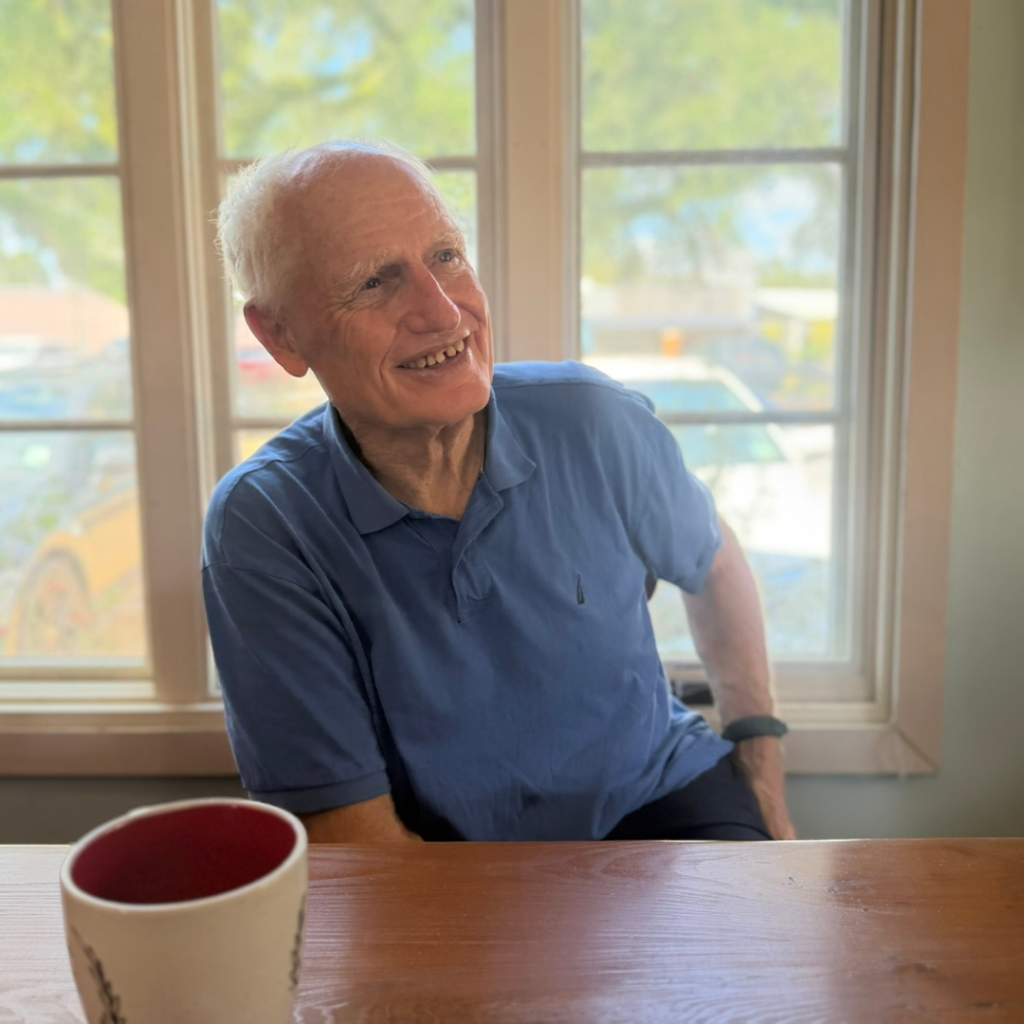
Kelly Ward sits at a long wooden table with his back to the window at the Birdman Coffeehouse in St. Francisville, the small, locally loved café on Commerce Street, one of the town’s many shops and restaurants along the main road. A pair of wingback chairs with worn seat cushions flank an upright piano across from him and one of his wife’s two paintings on display in Birdman hangs on the wall above the chairs, bright reminders of the life he and Kathryn built there.
He has a white mug in front of him with black cursive words across the front that read “home sweet home” and a wide smile across his face, lines crinkling at the corners of his eyes that represent a lifetime of laughter. He wears a light blue polo t-shirt, the same color as his eyes.
It’s 10:30 a.m., and he is savoring the last few sips of his daily latte. His breakfast of salmon and avocado toast, affectionately named “Kelly’s Toast” on the Birdman menu, is long gone.
He spots a friend a few tables away.
“Hello, Sam! How are you? You going to be there Sunday?” he calls out, referencing their monthly book club.
Without getting up from his table, Sam shakes his head, “No. I didn’t like the book and the Saints are going to be on.”
Ward laughs, a joyful and authentic laugh to go with his sharp sense of humor, and a grounded philosophy shaped by decades of difficult decisions.
After more than 30 years working for the Louisiana Department of Corrections, he retired in 2003 and has settled quite nicely into small town life. On Tuesdays and Thursdays, he meets a group of other retirees at Birdman – doctors, federal employees, business owners, teachers, nurses, and social workers.
“But no lawyers,” he said with a smile. “We don’t allow lawyers.”
Born in Oklahoma, Ward moved to Baton Rouge when he was a freshman in high school. After graduating from Broadmoor High School and then Louisiana State University with a degree in history, he took the civil service exam with no real idea of what he wanted to do after college.
“There were three options,” he said. “A state school for children with developmental disorders, the welfare office, or prison.”
He chose prison.
He still remembers his first day at Angola.
“It was 1971, and I was 22,” he said. “I didn’t even know where Angola was. I thought it was right off Highway 61. Instead, I had to drive down this 20‑mile winding road that ended at rusty barbed wire and a tower in front of the reception center.”
His shock matched that of many of the men entering the prison.
“I was young, and they were young too,” he said. “The guys from New Orleans, many of them had never left the city. They were shocked to see cows for the first time.”
As a classification officer, he and the team were responsible for interviewing every man entering the prison for the first time and determined their placement based on their crime, background, and psychological testing. At the time he assumed the position would be temporary.
“I figured I would work there for six months and find a real job,” he said, joking. But after his first promotion, he found his footing. “I thought that this is what I want to do. The work was interesting and important, and there was never, ever a boring day.”
The six months stretched into more than 30 years – three prisons, countless promotions, and a career defined by innovative thinking about how to prepare incarcerated men for life beyond the gate. He encouraged those with long sentences to stay involved in pro-social activities and educational opportunities to deter negative behavior while offering hope.
“Traditionally, people thought that if you had a life sentence, it was a waste of time to invest in you,” he said. “But the reality is that at some point you might get out. You didn’t want negative marks on your record. And if you have a life sentence, you may only get one chance to convince people you can come home. You don’t want to blow that one chance.”
He would help the men earn their high school diplomas, build their leadership skills, and organize projects to benefit both those inside prison and outside in the community.
“Some people thought I was crazy,” he said. “But a lot of people started buying into it.”
As his career grew, so did his family. He and his wife, Kathryn, met while working in corrections and have been married for 45 years. They raised a son and daughter and are now proud grandparents to four.
For 25 years, Ward was also a certified auditor with the American Correctional Association, traveling to different prisons across the country. And in 2022, he was inducted into the Louisiana Justice Hall of Fame.
He retired as the warden of David Wade Correctional Center in Homer, Louisiana, and that’s where he met a group of juvenile lifers – Andrew Hundley, executive director of Parole Project; Matthew Pineda, community engagement manager; and Mike Gachot, former reentry manager. At the time, they were teenagers, juvenile lifers in Wade’s N-5 unit.
“Anyone under 17 was housed there,” he said. “It was a controlled way to introduce them to the system.”
The juvenile lifers helped to build programs that strengthened their leadership skills and served the community inside and outside the prison, organizational skills that have served them well.
“What Andrew and Matt do every year with the (Redemption) luncheon, they were already doing in prison,” Ward said. “Same principles, same organizing, similar situation. It’s just on a larger scale now.”
Hundley said Warden Kelly played an instrumental role in helping to shape Parole Project.
“Kelly believed in us at a time when our futures were still uncertain,” Hundley said. “He gave us room to lead, to grow, and to see more in ourselves. A lot of what we’ve built at Parole Project today can be traced back to the opportunities he gave us.”
Despite his long career, his proudest accomplishment is the success of Parole Project.
“I’m proud of what Parole Project has made possible,” he said. “I helped prepare people for a future beyond prison and Parole Project helps them live it. It’s a far cry from the days when men walked out with $20 and a bus ticket. Back then, whatever progress they’d made could be washed away by circumstance.”
After retiring, Ward was appointed to the Louisiana Parole Board to fill a sudden vacancy. For eight months, he sat on a three‑member panel, weighing the same cases he once helped initiate.
“It was a full‑circle moment,” he said. “I was the one who wrote the intake interviews, and now I was using that information to make decisions about their release.”