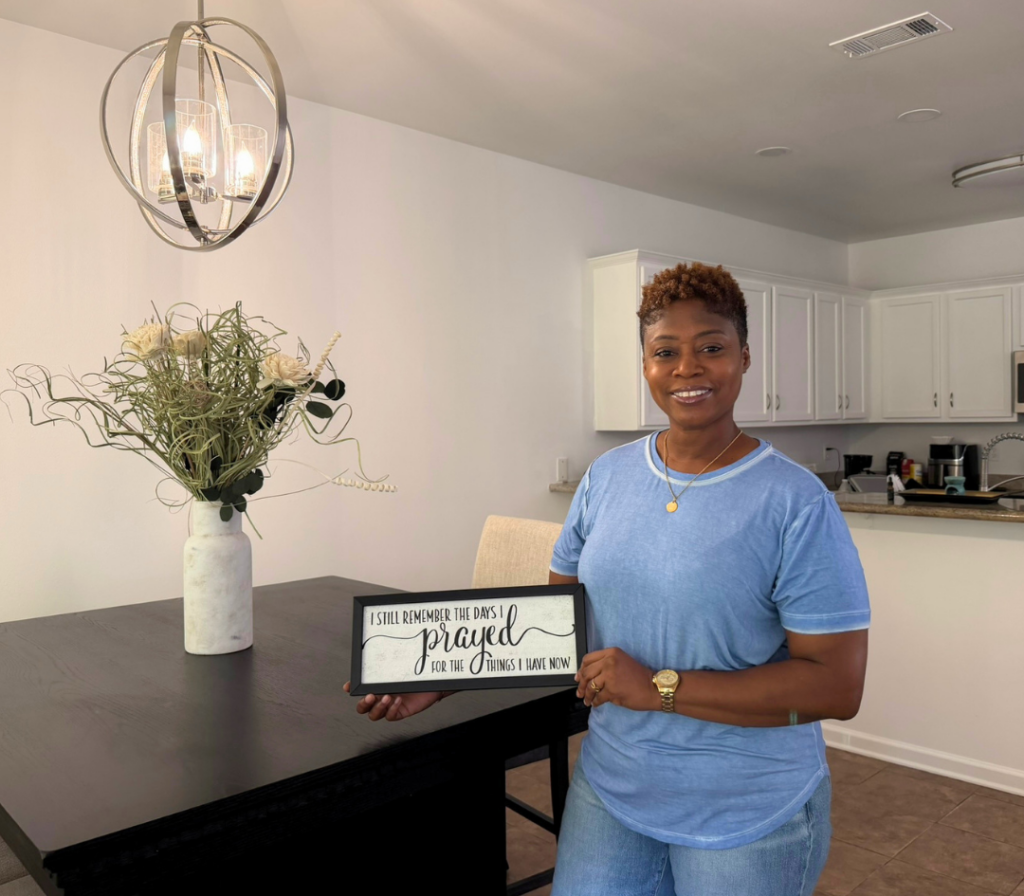
The first thing visitors notice when they walk into Tiffany’s Gramercy home is its warmth. Soft blue and brown pillows rest against an L-shaped leather couch. A white vase sits on the dining room table next to a small motivational sign. It reads: I still remember the days I prayed for the things I have now.
For Tiffany, those words are more than décor. They are a reminder of how far she has come.
After spending 16 years in prison, Tiffany was released in November 2023 and wasted no time pursuing the goals she had envisioned while incarcerated. Today she has a career, owns her own home and enjoys the stability she once imagined.
“I already had goals in front of me,” Tiffany said. “I came home ready to work, and it’s paying off.”
Tiffany’s story is an example of what happens when people returning home are met with opportunity, support, and dignity. She credits Louisiana Parole Project’s Employment Enhancement Program (EEP) with helping her turn those goals into reality.
“A program like Parole Project taught me many things,” she said. “Every now and then I get messages asking how I’m doing, and I share updates. I thank God for them.”
Since 2016, Parole Project has helped more than 720 men and women rebuild their lives after prison. EEP, a Workforce Advancement Hub initiative, expanded that impact by connecting returning citizens with employment, one of the strongest predictors of successful reentry.
EEP was established through a $900,000 grant awarded to Louisiana Parole Project in October 2022 by the U.S. Department of Justice’s Bureau of Justice Assistance (BJA) under its Improving Reentry Education and Employment Outcomes initiative. Implemented in September 2023, EEP provided Parole Project with the resources to significantly expand its employment services, particularly its outreach to potential employers. Although BJA funding and EEP concluded September 30, 2026, Parole Project’s Workforce Advancement Hub continues to build on the initiative’s success by connecting clients with employers, training opportunities, and pathways to meaningful careers.
As part of the federally funded initiative, Parole Project engaged an independent evaluator to assess the program’s effectiveness. An external evaluation conducted by Dr. Marcus Kondkar, Chair of the Department of Sociology at Loyola University New Orleans and released in September, found that EEP not only opened doors to jobs but also helped shift employer attitudes toward second-chance hiring.
Many employers reported that their EEP employees not only excelled but raised the bar for entire teams.
Kyla Romanach, Chief Public Defender for East Baton Rouge Parish, hired multiple EEP participants and quickly noticed a difference.
“They have a stronger work ethic,” Romanach said. “They are much more willing and eager to actually try to respond to the needs of the people on the other end of the phone because they understand what it is to be on the other end of the phone. And then I think that kind of sets a good example for others.”
Over the initiative’s three-year evaluation period from September 2023 through August 2026, Parole Project staff who led EEP contacted 375 potential employers throughout the Greater Baton Rouge area and built a network of 132 businesses willing to consider second-chance hiring. Staff successfully placed 270 formerly incarcerated people into stable employment across 132 employers, the majority of whom remain at their original work placements. The evaluation also found that just three percent of EEP participants returned to incarceration, compared to Louisiana’s statewide recidivism rate of 33 percent.
The study credits the recidivism success to Parole Project’s partnerships with the Greater Baton Rouge Economic Partnership and GNO, Inc., the organization’s careful screening process for job seekers, the dedicated support of its business and industry liaison, and the hands-on guidance provided throughout the employment journey. Parole Project staff also credit Louisiana Association of Business and Industry and Louisiana Department of Public Safety and Corrections for their efforts to advance second-chance employment opportunities.
“We didn’t just set out to help people find jobs. We wanted to help them build careers and give employers the confidence to lean into second-chance hiring,” said Andrew Hundley, executive director of Parole Project. “Professor Kondkar’s evaluation shows that when people have the right support and employers are willing to give them an opportunity, everyone benefits.”
But the initiative’s impact extends beyond the numbers.
While job placements are easy to measure, the program produced another, less visible outcome – changing workplace policies and perceptions. Approximately 80 of the 132 participating employers revised their internal hiring practices, removing restrictions tied to conviction histories after working with EEP participants and seeing their success firsthand.
Tiffany measures her success not only by what she has achieved, but by the life she now gets to live every day. With EEP’s help, she found more than a job. She began building a career that has helped her achieve the stability she envisioned for herself. The home she once dreamed of is now her reality and the goals she mapped out years ago have become accomplishments.
“I’m proud of myself, and I’m so grateful for the people who came into my life and helped me,” she said. “I’m proving what second chances are all about, and I’m just getting started.”