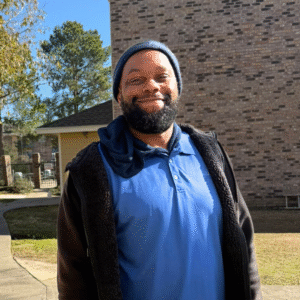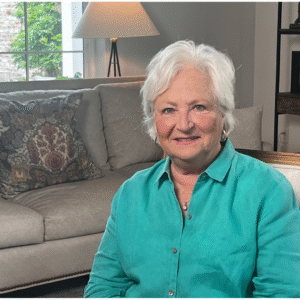
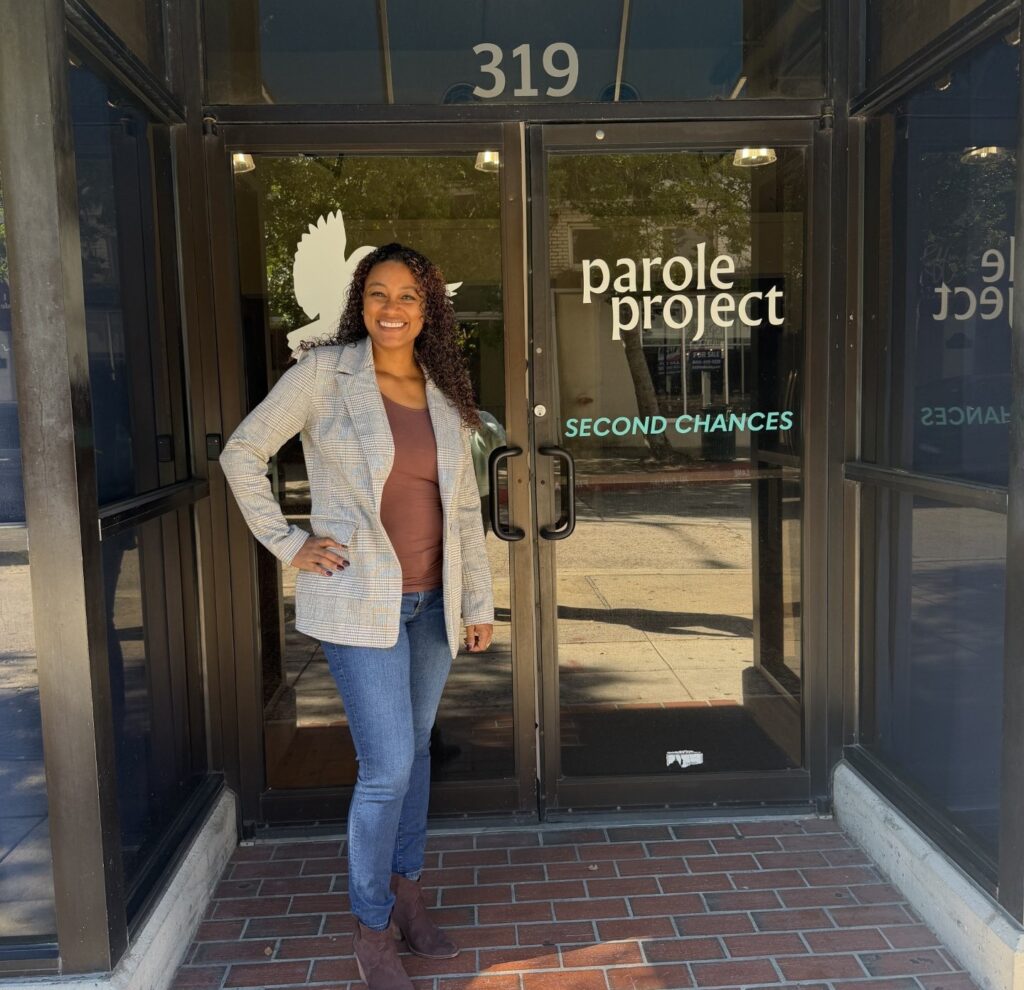
It’s 10:30 a.m. on a Wednesday and the large, open communal space in Parole Project’s downtown office buzzes with energy and conversation. A class on overcoming institutional habits has just ended and clients gather in the kitchen to chat, grab a cup of coffee, and a snack from the refrigerator.
Some have been home a few days, others a few weeks.
Three interns sit on the sectional in the main area of the office, laptops propped on their knees, focused and typing. A reentry staff member pauses in the doorway of Kelly Garrett’s door, with a red folder in one hand and a question on the tip of her tongue. Garrett, deputy director of client services for Parole Project, is on the phone with another reentry staff member, multi-tasking, rifling through a pile of paperwork on her desk and nodding at the staff member to come into her office. There’s a line of people waiting for her outside of her door and a giant whiteboard on one wall of her office with the last name of each client and the house they currently live in. On the opposite side of that wall is a desk with a credenza. A sign propped up on that credenza reads: “Please let me drop everything and work on your problem!”
If multi-tasking was a degree, she would have her PhD. Garrett is the problem solver of the office and the one that clients, staff, and volunteers seek out for help and advice. For those who really know her and for those she allows close, they love her. She has a beautiful smile, a caring heart, and gives the warmest hugs. But for those who just meet her, they may fear her. She is armed with a tough exterior and a no BS attitude.
“Kelly embodies what it means to serve with heart and purpose,” said Parole Project Executive Director Andrew Hundley. “Her care for our clients and her incredible ability to make things happen set a standard for all of us to follow.”
Garrett grew up in a mixed-race household in New Iberia and later Lafayette. Her mom is German, her dad is black. They met while her father was stationed with the Army in Germany and the love that her parents created splintered the relationship between Garrett’s mother and her parents.
As a child, Garrett struggled to find friends and fit in. She was ridiculed for being mixed-race and by the time she got to middle school, struggled with her identity.
“I had a tough time figuring out what social group I belonged in because everything was so segregated,” she said. “I didn’t fit into either group.”
When she got to high school, she cut her hair, got her braces off, swapped her glasses for contacts and shed everyone else’s expectations of her – determined to pave her own path.
“I said I’m going to be me, and I found people who liked me for me, and I ended up being a popular kid,” she said. “I was even on the homecoming court.”
After high school, she attended LSU where she received a bachelor’s degree in marketing. She had her daughter Jordan, now 23, and began a career in corporate America, first at Turner Broadcasting in Atlanta and then later at a local news station in Lafayette – building status and wealth and honing in on her tenacity, determination, and quest for acceptance.
“It was a high-paced corporate environment. I was in my 30s and living in Lafayette,” she said. “And I found myself at an organization where I was the only minority voice at an executive level, and I felt the pressure of being that only voice.”
And that’s when she met a woman who was the mother to a man who would change her world.
It was 2014 and her co-worker invited her to go visit her son in prison.
“She was like a mom to me who always spoke of her son and his innocence,” Garrett said. “She invited me to ride with her to see him on her birthday and listen to him preach at one of the churches inside the prison, and I was starting to feel this tug to do something different, so I said yes.”
Garrett had never been to a prison before but that day, they drove two hours from Lafayette to the Louisiana State Penitentiary at Angola to meet her co-worker’s son, Justin.
“It was very intimidating to me, going through the gate and getting sniffed by the dogs,” she said. “They searched you, and it was very mind-blowing. I remember walking into the visitation room and seeing mostly black men and I was once again reminded of the disparity.”
She witnessed Justin preach and felt like his message was geared toward her and what was going on in her life and when they ate lunch with his mom and joined hands to pray before the meal, she felt a jolt of electricity travel from their joined hands up her arm.
“I looked at him and immediately thought ‘Hell no,’” she said. And that hell no turned into a friendship and eventually a relationship that created so much purpose in Garrett’s life that she moved cities and jobs to help Justin and other men in a similar situation. She learned about Louisiana’s criminal and court systems, how to get laws passed, and about the parole process.
“I started meeting all of these people. and I was like these people are not criminals, they could be my grandfather, my dad, or my brother,” she said. “I got to know their stories and how they made a bad decision at one point but grew into different men.”
She dug into Justin’s case, read every court document, medical record, and police report and fell in love with not only Justin but the investigative work of peeling back the layers, realizing that his mother was right. She requested court documents from the parish he was convicted in and found herself in rooms with lawmakers, attorneys, and other public officials.
“I have a bulldog tenacity,” she said. “And I realized that this isn’t right, and it could happen anywhere to anybody. That’s what fueled my fire in helping Justin and doing the work that I’m doing.”
For nearly a decade, she helped Justin with his case.
“There comes a point in your life where you try to figure out your purpose and once I committed to my calling, doors started to open,” she said.
In 2017 she helped draft a bill that eventually became a law. Act 267 clarifies that any time spent in custody before a life sentence is imposed can be included in the waiting period before an individual can apply for a pardon or commutation. This change made Justin eligible to apply for clemency which eventually led to his parole eligibility.
“That was a huge and proud moment,” she said. “And I remember my friends were like, ‘Were you aware you just changed the law?’”
Their relationship grew and they got engaged while her career continued to evolve. Along the way, she met Andrew Hundley and Kerry Myers and learned about Parole Project. She was offered the position of Deputy Director of Client Services and accepted. She began working for Parole Project 15 months before Justin was paroled. It was a smaller staff back then – less than 10 employees – and she moved to Baton Rouge to take on that role.
Justin came home in March 2023 after nearly a decade of commitment and a life change, but the love story that fueled Garrett’s drive and purpose, ended one year later.
Garrett pauses when she shares this part of her story – a reminder of the vulnerability she felt placing the armor at her feet to open herself up completely to a man she loved and eventually armoring back up to navigate the pain of an ended relationship.
Her clarity outweighed her pain, and she started therapy to peel back her many layers, finding healing. In January, she traveled to Puerto Rico with a new mantra – “I will rid myself of the things that no longer serve me.”
Today, Garrett is proud of the work she has accomplished. Parole Project has helped more than 650 men and women return home after prison and she is an integral part of that process. She is committed to the work, often she is the first to arrive at the office and the last to leave. She manages a reentry staff and social work team of 12 employees and is one of the first people a client sees when they come to the offices of Parole Project after prison. She coordinates housing assignments, shops for items for the houses, manages the class schedule and oversees the intern program. When she’s not working, she loves to unwind at the end of a long day with a glass of wine and a Netflix show. She also loves to travel, work out, and spend time on the beach.
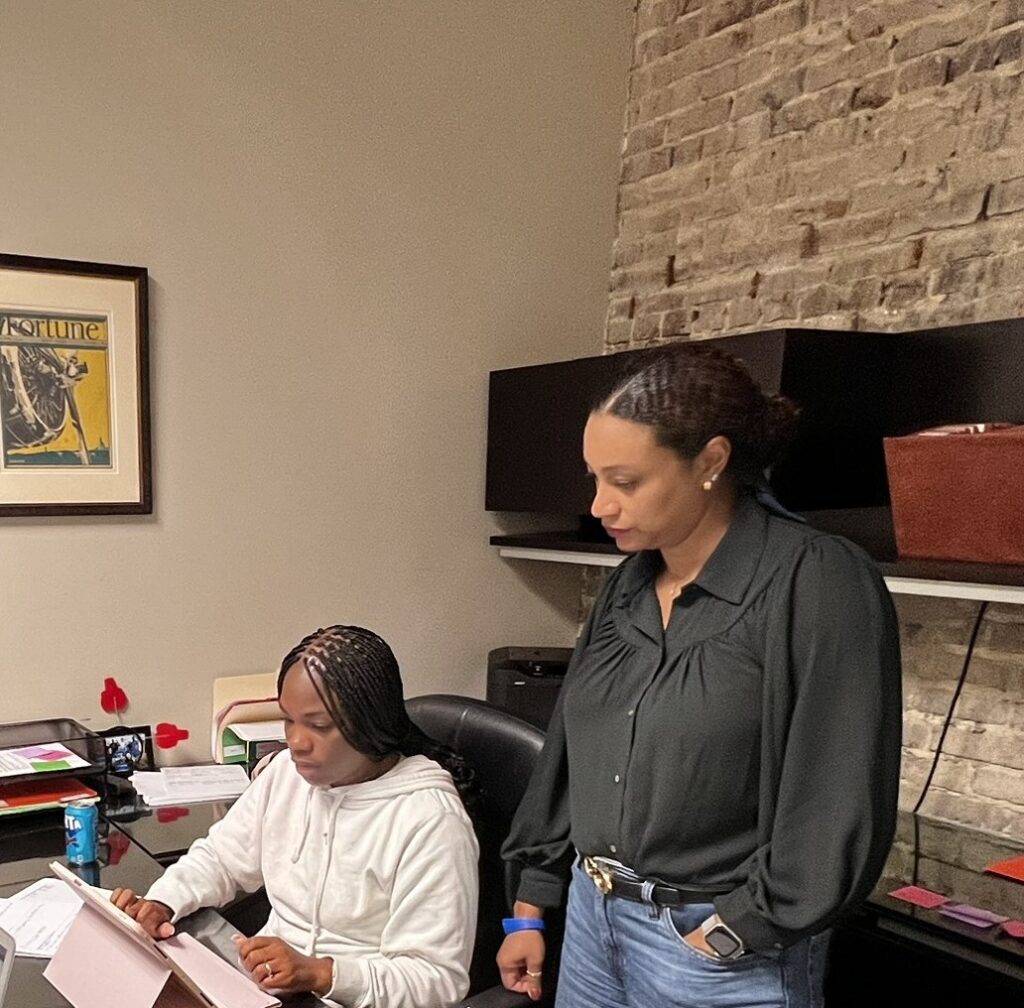


And she really loves the purpose she finds in work – it’s not just a job, it’s a calling.
“What keeps me going is meeting a client for the first time and then seeing the person they become six weeks later,” she said. “I love seeing that transition and knowing that it can be hard but when they take the advice given and prepare for the next step, they succeed. And that brings me a lot of joy.”