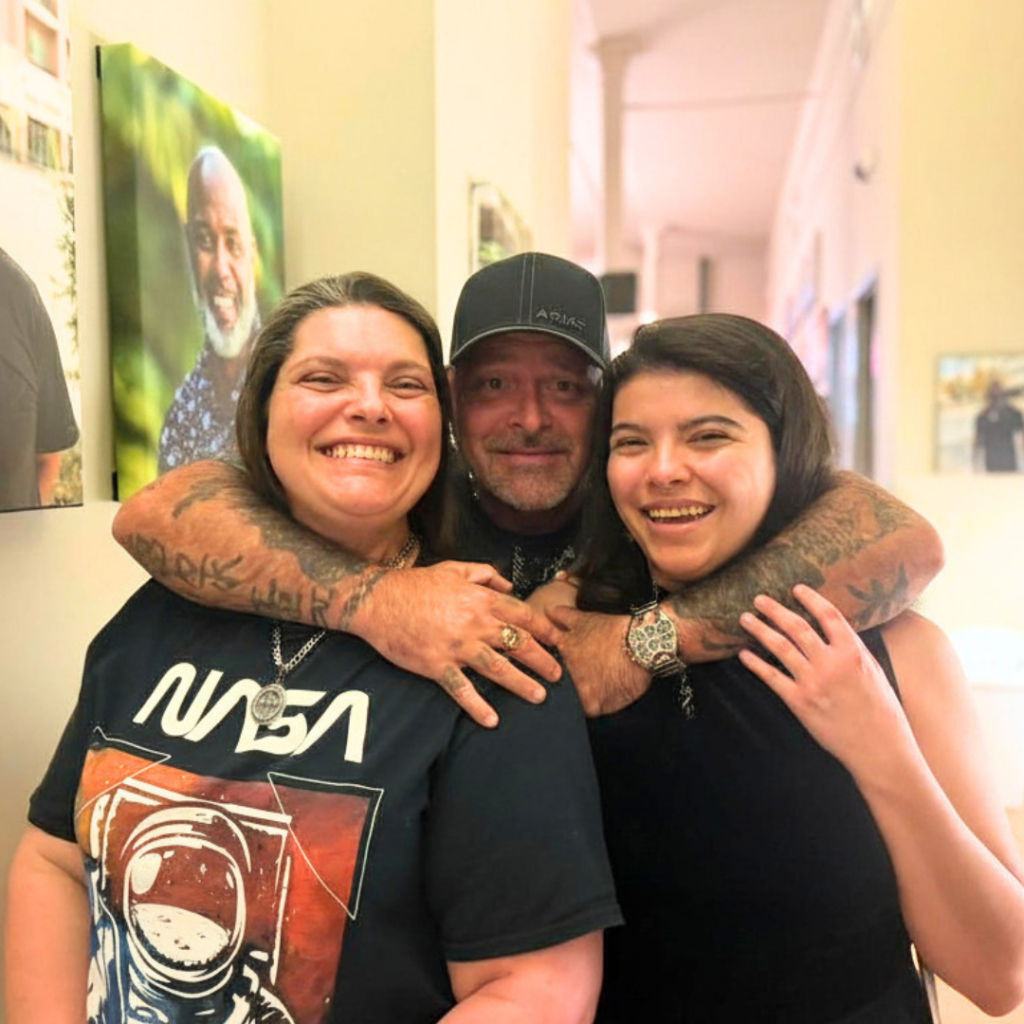
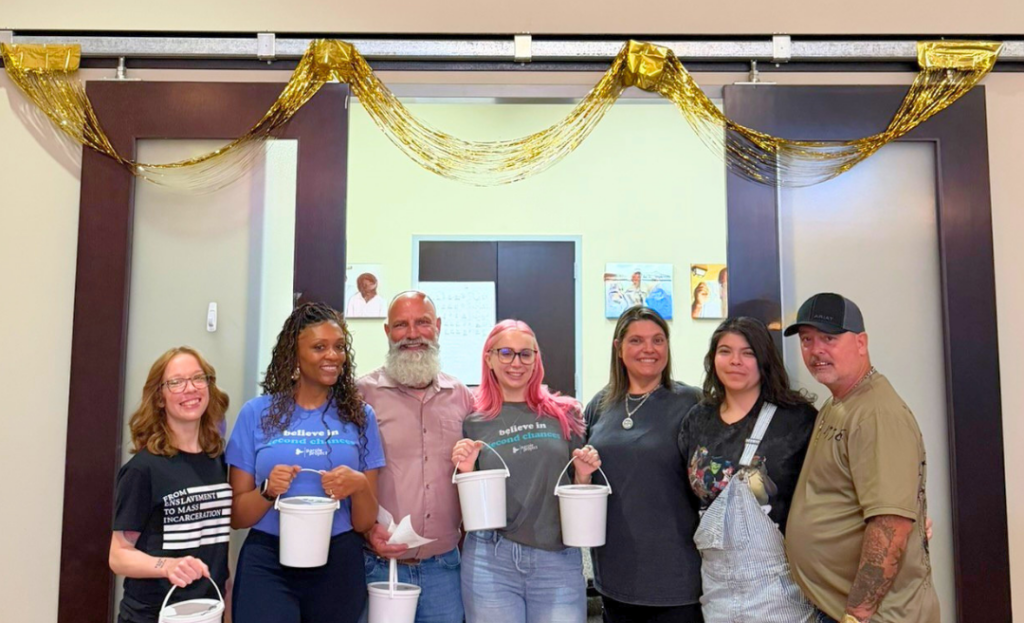
Shawn walks into Parole Project’s offices with his fiancée, Jessica, and his daughter, Jordan, carrying white tubs filled with warm chocolate chip cookies. He has been home less than a month after spending 32 years in prison. The cookies are gifts for the staff helping to guide his release.
They pause for a photo in the hallway. Shawn is grinning, standing shoulder‑to‑shoulder with the people who built his reentry plan and the family waiting for him on the outside. After three decades in prison, it is a moment that feels both ordinary and extraordinary and he is thankful for the support of his family and Parole Project.
“Because life is overwhelming, having both sides of support doesn’t only give you a soft break back into a world that we no longer know, it teaches you how to cope and manage,” Shawn said. “It starts us off on the right path and gives hope to our future.”
Shawn is fortunate. His return home was supported by both Parole Project and a family ready to welcome him back. But for many people released after long terms of incarceration, that support simply isn’t there.
A new research study released in May, “I Don’t Know You No More, and You Don’t Know Me: Complicated Family Dynamics for Those Formerly Serving Life Sentences” by Christian Bolden, Brittnie Aiello, and Alison Colby, documents just how common it is for people in Louisiana to come home without meaningful family connections.
Based on 92 in‑depth interviews with Parole Project clients – 71 men and 21 women – released from life without parole, practical life, or other long sentences in Louisiana, the study examines three central themes: family contact, experiences while incarcerated, and the reentry process. Of the participants, 60 were Black, 26 were white, three were Hispanic, two were Asian, and one was biracial. They had served 20 to 50 or more years in prison, and many were incarcerated as adolescents.
Bolden, formerly a criminology professor at Loyola University New Orleans and now at Rochester Institute of Technology in Rochester, NY, and his co‑authors spent three years interviewing people for the study. During that time, they identified three primary ways family networks break down during long‑term incarceration: death, drift, and disavowal. These gaps leave many returning people without a family safety net, making peer‑based reentry programs essential for successful reintegration.
Bolden writes: The majority of respondents who still had family contact received joyous celebrations from their families upon release. However, about one-third of our sample have little to no contact with their family. In this study, we explore some of the challenges and disadvantages of maintaining familial relationships that help to explain why many of our respondents sought to live independently from their families, limit contact, or forgo family relationships altogether.
According to the study, Louisiana Parole Project fills that gap. Since 2016, the organization has helped nearly 700 people return home. Nearly two‑thirds of its staff are formerly incarcerated, and the Baton Rouge‑based nonprofit provides wraparound support with reentry management and classes, mental health and substance abuse services, employment assistance, transportation, and housing. Parole Project owns and operates 48 transitional properties across the city.
“This research confirms what we have seen in our work for years,” said Parole Project Executive Director Andrew Hundley. “Family support is important, but not everyone has it. Some people have outlived their families, some relationships have faded over decades, and some families are struggling with poverty themselves. Reentry organizations like Parole Project help fill that gap with housing, guidance, and the steady support people need to rebuild their lives.”
The study says that death is the most common and irreversible loss that many incarcerated people encounter. The death of parents often severed the last remaining link to extended family.
More than 45 percent of participants said they lost their primary supporters while in prison, and 19 percent said most or all of their family had died.
Henry’s story illustrates this reality. Raised by his grandparents, he entered prison at 17. When he was released 57 years later, both grandparents were gone. Parole Project became the support system he no longer had.
The slow unraveling of connection or drift is the second issue many long-term prisoners face upon return, with 37% of participants describing some form of drift, specifically relationships fading over years or decades. The study said causes of drift included family exhaustion, poverty, emotional strain, the incarcerated person withdrawing to protect loved ones, and barriers like call costs, distance, and restrictive prison conditions.
Freddie was incarcerated for 33 years. While he has five grown daughters who are successful and doing well, he said, “They hardly know me.” He said he is thankful they are prospering and doing well even though he is not in their lives.
The third issue many people face when returning home after long sentences is disavowal or rejection. According to the study, 14 percent of participants experienced family rejection, with some families opposed to their release at parole hearings and other family members who cut ties entirely.
Carolyn was sentenced to life without parole for a homicide she maintains was an act of self‑defense. As she prepared for release, Bolden and his team learned, she made the difficult decision to live at Parole Project indefinitely, largely because of a disagreement she had with the person she was going to live with after being released. She said the fallout created familial strains, including a devastating loss when her daughter stopped communicating with her.
Shawn said he’s grateful that Parole Project stepped in to fill a gap when he came home, and he knows that while he has family support, many others don’t.
“Parole Project gives us financial support to get started which all of our family doesn’t have the means to do. They barely get by on their own so having both sides of support is the best way to manage and gives you the best opportunity for success,” he said. “The world needs to know how much of a blessing Parole Project is.”